Does Video Recorded at 120fps Uploaded on Youtube Play Incorrectly for People Running at 60hz
Ultra HFR: 240fps Real Time Video Now Possible Today. 1000fps Tomorrow. [UPDATED]
ORIGINALLY WRITTEN Feb 2018. Updated June 2020 with new data.
Always since the Blur Busters Holiday Special article about the Amazing Journeying to 1000Hz Displays and the earlier true 480Hz monitor tests, Mistiness Busters has been paying much more than attention to HFR video developments.
We are the only website in the world to exclusively talk nigh "Better Than 60Hz". This universe also includes 120fps HFR. Yet, there are also experiments with Ultra HFR — the fine art of displaying video at ultra loftier frame rates (HFR 240fps, 480fps and 1000fps) in real-time on ultra loftier refresh rate displays. Not tiresome motion!
Longtime readers are familiar with our world'due south get-go embedded 120fps HFR web browser videos and world'due south outset 120fps gameplay video 5 years ago (Twelvemonth 2013)
- World'southward Commencement 1080p Embedded 120fps Video Game Recording
- 120fps HFR Video in Real Fourth dimension
Now, we are testing video beyond 120 frames per second!
Ultra HFR: Truthful 240 fps Real Fourth dimension
Here is a method of creating 240 frame per second HFR video, for play back on today's 240 Hz eSports monitor.
- Get whatever favourite slo-mo camera capable of 240fps.
…From smartphones to GoPros to Phantom Flex cameras, many cameras at present can do 240fps. - Get a GPU capable of 4K60 playback.
…GPUs capable of 4K 60fps playback are also able to practise 1080p 240fps playback. - Get a truthful-240Hz gaming monitor. See List of Best Gaming Monitors.
- Download and install ffmpeg.
- Record video in normal 240fps slo-mo. Resulting file is 30fps.
- If you need to use a video editor, edit while video is all the same slo-mo. Then consign an .MP4 video.
- Finally, run this ffmpeg command line to speed upwards the video back to real-fourth dimension playback.
This speeds up video to play at viii times the frame rate, converting 30fps to 240fps.ffmpeg -i slowmo240.mp4 -r 240 -vf "setpts=(one/ 8 )*PTS" -an realtime240.mp4 - Play the video in your player (VLC, MPC-HC, Windows Media, etc) on your 240 Hz display.
…You may need to experiment with different video players to find the best 240fps experience.
Loftier speed cameras, designed for slo-mo, often do not record audio well. At the moment, the best mode to add audio is to record the sound separately, and use a command line utility to dub the sound onto the sped-up file.
The aforementioned general instructions apply to 480fps and 1000fps HFR, with different speedup factors (replace number "8" with the advisable speedup factor).
Share your results in the new Mistiness Busters Forums High Frame Charge per unit (HFR) Video discussion expanse!
Time to come 1000fps HFR: 240fps is not the final borderland
In the newly created Blur Busters HFR Forum, there is a thread worth reading almost Ultra HFR.
The art of playing truthful 1000fps existent time on truthful 1000Hz displays: Cinematography of 2030s: Ultra HFR (1000fps at 1000Hz!)
Experimental 1000 Hz displays are already available, and will eventually be cheap within ane human generation. Now even some smartphones are also gaining ultra-high frame charge per unit video recording capabilities too. This presents opportunities for cheap Ultra HFR in the coming years!
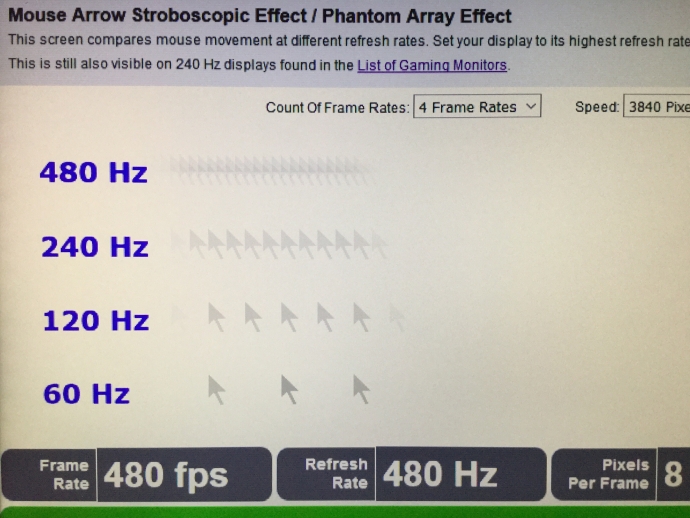
By doing 1000fps HFR on a 1000Hz brandish, you tin simultaneously avoid camera motility blur and avoid display motility blur and avoid stroboscopic effects. Strobless low-persistence (blurless sample-and-hold) without flicker is successfully achieved with k Hz experimental laboratory displays, and is also useful with Ultra HFR video.
Merely why do UltraHFR?
Source Camera Mistiness and Destination Brandish Blur is Additive
Today, modern displays are sample-and-agree, for ergonomic flicker-free reasons, which creates a Hz bottleneck. No CRT flicker, merely far more than motion blur than a CRT tube.
A camera shutter 1/60sec combined with common brandish 1/60sec persistence = creates 2/60sec worth of motion blur. That's 1/30sec of movement blurring seen past human eyes when playing 60fps video taken with 1/60sec shutter, played onto a 60Hz sample-and-agree brandish! This is even bold instant pixel response GtG 0ms, otherwise, there's worse motion blur than 1/30sec!
To reduce camera-side motion blur massively, a content creator can use a fast sports shutter 1/1000sec on the photographic camera. Only this volition e'er be bottlenecked by destination display blur, from the sample-and-hold upshot.
This diagram beneath is from our Pixel Response FAQ, GtG versus MPRT (the 2 dissimilar pixel response benchmarks). Flickerfree displays (sample-and-hold displays such as LCDs, OLEDs, MicroLEDs) produces a mandatory guaranteed added display-side motion mistiness:
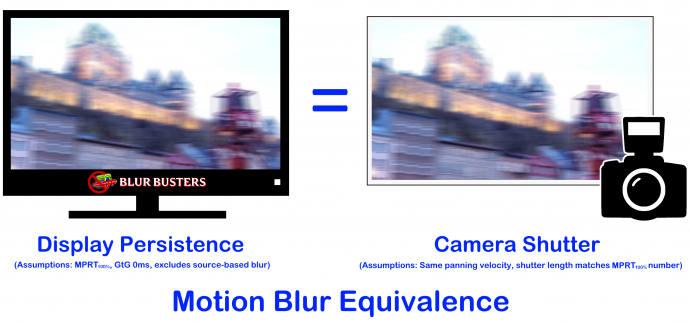
To see this for yourself, we have TestUFO move animations that demonstrates enforced motion mistiness caused by display persistence: TestUFO animation demo #1, TestUFO animation demo #two. As a general dominion of pollex, the refresh rate of a flickerfree brandish is typically the guaranteed minimum display motion blur: 120Hz = 1/120sec = 8.3ms of motion blur = 8.three pixels of blurring per thousand pixels/sec move.
To eliminate all movement blur weak links, both source shutter (i/1000sec) and display persistence (1ms MPRT) should be fast. There are two means to reduce display motion blur:
- Shorten display's frame visibility time via impulsing (CRT, plasma, black frames, etc)
- Shorten brandish's frame visibility fourth dimension via college frame charge per unit
The problem with arroyo (1) is you tin produce stroboscopic stepping furnishings (phantom arrays) for fast-camera-shutter material such as sports, see The Stroboscopic Effect of Finite Frame Charge per unit Displays. Besides, existent life doesn't flicker or strobe, so impulsing is a humankind band-assist for simulating reality.
Solving motion blur and stroboscopic effect simultaneously requires ultra high frame rates: 1000fps at 1000Hz! I can practice a 360-degree camera shutter blurlessly. A full-open shutter is only 1 millisecond during 1000fps video. A 1000Hz display is blurless sample-and-hold via sheer fauna Hz.
This makes video look closer to real life, closer to a Holodeck — with no framerate-induced limitations like forced motionblur or forced stroboscopic effects. This tin make 1000fps UltraHFR less nauseating than 120fps HFR.
Diminishing Curve: Next Pace Afterward 120fps HFR should be 1000fps UltraHFR
Time-wise, the difference between 120fps HFR versus 1000fps HFR is roughly as big as the difference between 60fps and 120fps. This is because ane/60sec and 1/120sec is an 8.3ms divergence, while the departure between ane/120sec and i/1000sec is a vii.3ms departure. There is a curve of diminishing points of returns, but the massive jump upwardly to 1000fps HFR greatly compensates.
- 1/60sec = 16.7ms blur
- i/120sec = viii.33ms mistiness — observe 8.3ms improvement over i/60sec
- 1/1000sec = 1ms mistiness — observe 7.3ms improvement over 1/120sec
As a result, a big bound up the diminishing curve of returns is required to get as dramatic improvement equally the bound between 60fps and 120fps HFR. Therefore nosotros believe that the side by side step later on 120fps HFR should now be 1000fps HFR.
Too, UltraHFR benefits higher resolution more. 1000fps UltraHFR would not be nearly as useful for standard-definition video material (less than i pixel of motion mistiness for one-screen-width-per-2nd motion) simply would be hugely beneficial to 8K material (viii pixels of motion blur for i-screen-width-per-2nd panning motion)
Very Of import UltraHFR Tips For Max Frame Rate Video
When trying to force a display to go maximum motion clarity, there are some all-time practices.
In the earth of experiments with 240fps, 480fps and 1000fps real-fourth dimension video playback on ultra-high Hz displays, these are very important considerations from recent research:
- Display persistence is additive to camera persistence (shutter). A one/60sec persistence display combined with a 1/60sec shutter video, generates a combined two/60sec of man-perceived motion blur. Every bit a rule of pollex, your common perceived blur is often at to the lowest degreetwice the camera shutter, and often much worse (e.m. 1/1000sec shutter combined with ane/60sec display persistence). This means that on nigh displays, a 1/1000sec shutter at 60fps only has barely one-half the motion mistiness of 1/60sec shutter, just because information technology is bottlenecked by one/60sec brandish persistence! Also, a display that has a pixel response (GtG) that is a significant percentage of a refresh bike at its max Hz — will besides limit UltraHFR benefits even further.
Yous must be aware of howboth source (Camera) and destination (Display) persistence combines in movement blur in guild to sympathize limitations to UltraHFR benefits - Resolution reduction is a large problem at higher frame rates on current cameras. Recommended is to oversample past recording at almost 2x resolution (e.grand. true 4K) and then downconvert (e.g. to 1080p). For this reason, information technology is hugely preferable to get a superior loftier speed camera (e.grand. Phantom Flex 4K) instead of smartphone photographic camera (eastward.g. iPhone in Slo-mo) when generating source footage.
You must minimize resolution loss to preserve UltraHFR benefits - Compression is a big blur problem. Utilise less compression
You must minimize compression to preserve UltraHFR benefits - Lens autofocus is sometimes difficult during filming moving imagery. It is especially amplified when your motility clarity is extremely sharp, to the point where any camera focus issues brainstorm to get visible.
Yous must brand sure focus is sharp during fast motion to preserve UltraHFR benefits - Exist aware of the brutal cycle effect where higher resolutions demands college refresh rates to eliminate resolution limitations. The difference betwixt static images and moving images become much more pronounced at 8K than it is for 1080p, since move blur is time-based (e.1000. same corporeality of mistiness per inch, affects more pixels on college DPI displays). This is especially difficult because current camera technology frequently goes lower resolution at higher frame rates.
You must utilize a higher resolution to preserve UltraHFR benefits - High frame rates benefits loftier movement fabric. A great example is sportsfield panning, downhill skiing, BMX racing, motorcar racing, etc. When the get-go HDTVs arrived, some camera operators reported they had to intentionally slow down panning and operate slightly differently because LCD HDTV mistiness (of the first apartment console HDTVs) was much worse than quondam CRT motion clarity.
UltraHFR benefits fast motion textile very significantly.
Many historical frame charge per unit tests about frame charge per unit benefits take ofttimes neglected to consider (1) (2) (three) (4) (5) (6) simultaneously .
Research indicates that any i of the to a higher place can be a weak link in eliminating the benefits of UltraHFR video, and ane must advisedly control the variables to give truly human-visible benefits of UltraHFR. If you are planning any experiments in UltraHFR at maximum frame rates for the best possible Holodeck-league move clarity, information technology is very important to know and understand the above variables.
4 Elementary Fixes for Temporally Accurate Reality Simulation
To eliminate all weak links, so that remaining limitations is human being-vision based. No camera-based or display-based limitations above and beyond natural human vision/brain limitations.
- Prepare source stroboscopic effect (camera): Must use a 360-degree photographic camera shutter;
- Gear up destination stroboscopic effect (display): Must use a sample-and-agree display;
- Ready source motion blur (camera): Must apply a brusque camera exposure per frame;
- Set up destination motion blur (display): Must employ a short persistence per refresh wheel.
Therefore;
- Ultra high frame charge per unit with 360-degree camera shutter is likewise short camera exposure per frame;
- Ultra high refresh charge per unit with sample-and-hold display is also short persistence per refresh wheel,
Therefor, to solve (i), (2), (three), (4) simultaneously requires ultra high frame rates at ultra loftier refresh rates.
We Love Hollywood Movie Maker Mode Too: Full Command Of Entire Mistiness Chain
1000fps UltraHFR gives the director full control of motility blur, too. 1000fps UltraHFR is a huge venn digram capable of embedding the entire range of framerates in humankind.
With such fine granularities on an ultra-high-Hz displays, refresh rates no longer need to be evenly divisible by frame rate, in order to look shine!
When 18fps, 23.97fps, 24fps, 25fps, 50fps, 59.94fps, 48fps, 60fps, are all played to a 1000Hz display, all framerates have their original look and motion blur. They play judderlessly without noticable pulldown judder (i.eastward. 3:2 pulldown) considering of the unnoticeable ultrafine refresh rate granularity.
In other words, 24fps video embedded inside a UltraHFR-capable video file, played on a 1000Hz display, looks exactly like a 24Hz brandish — all with original camera motion blur and persistence blur.
The ability to go as blurry as y'all want (preserve camera mistiness / erstwhile frame rates) — and the ability to go well-nigh cipher-blur equally you want — is an amazing property of UltraHFR video files in the quadruple-digit framerate range.
Conclusion
At Blur Busters, we are amongst the few people in the world to accept witnessed Ultra HFR video!
Being the founder of Mistiness Busters (Marking Rejhon), I used to piece of work with video processor companies (RUNCO, Key Digital, and a PCI card containing a Faroudja chip). I was the writer of the world'due south outset open source 3:2 pulldown deinterlacer algorithm 20 years ago in dScaler (Year 2000, Internet Archive).
We believe this is very useful for many applications in the coming decade, from speciality theatre, virtual reality, entertainment park rides, advanced movie theater, truly immersive virtual vacations, "Holodeck" video, and other applications once more 1000 Hz displays are commercially available outset sometime inside the next decade and beyond.
Related Reading
- 480Hz Displays — World'southward Starting time 480Hz Monitor Review
- 1000Hz Displays — Blur Busters Police force: The Amazing Journey To Future 1000Hz Displays
- Frame Rate Distension Technology — More than Frame Rate With Less GPU Power Per Frame
- Stroboscopic Effects — The Stroboscopic Effect of Finite Frame Rate Displays
- Discussion Forum — Loftier Frame Rate Video (HFR)
Source: https://blurbusters.com/ultra-hfr-240fps-real-time-video-now-possible-today-1000fps-tomorrow/
0 Response to "Does Video Recorded at 120fps Uploaded on Youtube Play Incorrectly for People Running at 60hz"
ارسال یک نظر