what three-headed mythological creature guarded the entrance to hades?
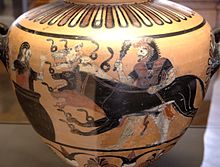
Heracles, wearing his characteristic king of beasts-pare, lodge in right hand, leash in left, presenting a iii-headed Cerberus, snakes coiling from his snouts, necks and front end paws, to a frightened Eurystheus hiding in a behemothic pot. Caeretan hydria (c. 530 BC) from Caere (Louvre E701).[one]
In Greek mythology, Cerberus (;[2] Greek: Κέρβερος Kérberos [ˈkerberos]), often referred to as the hound of Hades, is a multi-headed domestic dog that guards the gates of the Underworld to forestall the dead from leaving. He was the offspring of the monsters Echidna and Typhon, and was usually described every bit having three heads, a ophidian for a tail, and snakes protruding from multiple parts of his body. Cerberus is primarily known for his capture past Heracles, the terminal of Heracles' twelve labours.
Descriptions [edit]
Descriptions of Cerberus vary, including the number of his heads. Cerberus was usually three-headed, though not always. Cerberus had several multi-headed relatives. His begetter was the multi snake-headed Typhon,[3] and Cerberus was the brother of three other multi-headed monsters, the multi-snake-headed Lernaean Hydra; Orthrus, the ii-headed dog who guarded the Cattle of Geryon; and the Chimera, who had three heads: that of a king of beasts, a goat, and a snake.[iv] And, like these close relatives, Cerberus was, with only the rare iconographic exception, multi-headed.
In the earliest clarification of Cerberus, Hesiod'southward Theogony (c. 8th – 7th century BC), Cerberus has fifty heads, while Pindar (c. 522 – c. 443 BC) gave him one hundred heads.[5] Still, later writers almost universally give Cerberus 3 heads.[6] An exception is the Latin poet Horace's Cerberus which has a single dog head, and 1 hundred serpent heads.[7] Perhaps trying to reconcile these competing traditions, Apollodorus's Cerberus has three canis familiaris heads and the heads of "all sorts of snakes" forth his back, while the Byzantine poet John Tzetzes (who probably based his account on Apollodorus) gives Cerberus l heads, three of which were dog heads, the rest being the "heads of other beasts of all sorts".[8]

Heracles, chain in left hand, his club laid aside, calms a two-headed Cerberus, which has a snake protruding from each of his heads, a mane down his necks and back, and a snake tail. Cerberus is emerging from a portico, which represents the palace of Hades in the underworld. Between them, a tree represents the sacred grove of Hades' wife Persephone. On the far left, Athena stands, left arm extended. Amphora (c. 525–510 BC) from Vulci (Louvre F204).[ix]
In art Cerberus is most commonly depicted with 2 dog heads (visible), never more than than three, but occasionally with merely one.[10] On one of the ii earliest depictions (c. 590–580 BC), a Corinthian cup from Argos (run across below), now lost, Cerberus was shown every bit a normal unmarried-headed dog.[11] The first appearance of a 3-headed Cerberus occurs on a mid-sixth-century BC Laconian cup (encounter below).[12]
Horace's many serpent-headed Cerberus followed a long tradition of Cerberus being part snake. This is perhaps already unsaid equally early as in Hesiod's Theogony, where Cerberus' female parent is the half-snake Echidna, and his father the snake-headed Typhon. In fine art Cerberus is often shown as being part ophidian,[13] for example the lost Corinthian loving cup showed snakes protruding from Cerberus' body, while the mid 6th-century BC Laconian loving cup gives Cerberus a snake for a tail. In the literary record, the commencement certain indication of Cerberus' serpentine nature comes from the rationalized business relationship of Hecataeus of Miletus (fl. 500–494 BC), who makes Cerberus a large poisonous snake.[14] Plato refers to Cerberus' composite nature,[15] and Euphorion of Chalcis (3rd century BC) describes Cerberus as having multiple snake tails,[16] and presumably in connection to his serpentine nature, associates Cerberus with the creation of the poisonous aconite plant.[17] Virgil has snakes writhe around Cerberus' neck,[xviii] Ovid's Cerberus has a venomous mouth,[nineteen] necks "vile with snakes",[20] and "hair inwoven with the threatening snake",[21] while Seneca gives Cerberus a mane consisting of snakes, and a single snake tail.[22]
Cerberus was given various other traits. According to Euripides, Cerberus not only had iii heads merely three bodies,[23] and according to Virgil he had multiple backs.[24] Cerberus ate raw flesh (according to Hesiod),[25] had eyes which flashed burn down (according to Euphorion), a three-tongued mouth (according to Horace), and acute hearing (co-ordinate to Seneca).[26]
The Twelfth Labour of Heracles [edit]
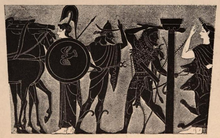
Athena, Hermes and Heracles, leading a two-headed Cerberus out of the underworld, as Persephone looks on. Hydria (c. 550–500 BC) attributed to the Leagros Group (Louvre CA 2992).[27]
Cerberus' only mythology concerns his capture by Heracles.[28] As early on equally Homer we learn that Heracles was sent by Eurystheus, the king of Tiryns, to bring dorsum Cerberus from Hades the rex of the underworld.[29] According to Apollodorus, this was the twelfth and concluding labour imposed on Heracles.[thirty] In a fragment from a lost play Pirithous, (attributed to either Euripides or Critias) Heracles says that, although Eurystheus allowable him to bring back Cerberus, information technology was not from any desire to see Cerberus, just just because Eurystheus idea that the chore was incommunicable.[31]
Heracles was aided in his mission past his existence an initiate of the Eleusinian Mysteries. Euripides has his initiation being "lucky" for Heracles in capturing Cerberus.[32] And both Diodorus Siculus and Apollodorus say that Heracles was initiated into the Mysteries, in preparation for his descent into the underworld. According to Diodorus, Heracles went to Athens, where Musaeus, the son of Orpheus, was in charge of the initiation rites,[33] while co-ordinate to Apollodorus, he went to Eumolpus at Eleusis.[34]
Heracles as well had the aid of Hermes, the usual guide of the underworld, likewise as Athena. In the Odyssey, Homer has Hermes and Athena as his guides.[35] And Hermes and Athena are often shown with Heracles on vase paintings depicting Cerberus' capture. By most accounts, Heracles fabricated his descent into the underworld through an entrance at Tainaron, the most famous of the diverse Greek entrances to the underworld.[36] The identify is get-go mentioned in connectedness with the Cerberus story in the rationalized business relationship of Hecataeus of Miletus (fl. 500–494 BC), and Euripides, Seneca, and Apolodorus, all have Heracles descend into the underworld there.[37] However Xenophon reports that Heracles was said to have descended at the Acherusian Chersonese near Heraclea Pontica, on the Blackness Body of water, a place more than normally associated with Heracles' exit from the underworld (encounter below).[38] Heraclea, founded c. 560 BC, perhaps took its name from the association of its site with Heracles' Cerberian exploit.[39]
Theseus and Pirithous [edit]
While in the underworld, Heracles met the heroes Theseus and Pirithous, where the ii companions were being held prisoner by Hades for attempting to carry off Hades' wife Persephone. Along with bringing back Cerberus, Heracles also managed (usually) to rescue Theseus, and in some versions Pirithous every bit well.[40] According to Apollodorus, Heracles constitute Theseus and Pirithous well-nigh the gates of Hades, spring to the "Chair of Forgetfulness, to which they grew and were held fast by coils of serpents", and when they saw Heracles, "they stretched out their hands every bit if they should be raised from the dead by his might", and Heracles was able to free Theseus, but when he tried to heighten upward Pirithous, "the earth quaked and he let become."[41]
The earliest evidence for the interest of Theseus and Pirithous in the Cerberus story, is plant on a shield-band relief (c. 560 BC) from Olympia, where Theseus and Pirithous (named) are seated together on a chair, arms held out in supplication, while Heracles approaches, almost to draw his sword.[42] The earliest literary mention of the rescue occurs in Euripides, where Heracles saves Theseus (with no mention of Pirithous).[43] In the lost play Pirithous, both heroes are rescued,[44] while in the rationalized account of Philochorus, Heracles was able to rescue Theseus, but not Pirithous.[45] In i place Diodorus says Heracles brought dorsum both Theseus and Pirithous, by the favor of Persephone,[46] while in another he says that Pirithous remained in Hades, or co-ordinate to "some writers of myth" that neither Theseus, nor Pirithous returned.[47] Both are rescued in Hyginus.[48]
Capture [edit]
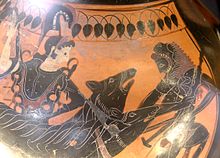
Athena, Heracles, and a two-headed Cerberus, with mane down his necks and back. Hermes (non shown in the photograph) stands to the left of Athena. An amphora (c. 575–525 BC) from Kameiros, Rhodes (Louvre A481).[49]
There are diverse versions of how Heracles accomplished Cerberus' capture.[50] According to Apollodorus, Heracles asked Hades for Cerberus, and Hades told Heracles he would let him to accept Cerberus but if he "mastered him without the use of the weapons which he carried", and then, using his lion-skin as a shield, Heracles squeezed Cerberus around the head until he submitted.[51]
In some early on sources Cerberus' capture seems to involve Heracles fighting Hades. Homer (Iliad 5.395–397) has Hades injured by an arrow shot past Heracles.[52] A scholium to the Iliad passage, explains that Hades had commanded that Heracles "master Cerberus without shield or Atomic number 26".[53] Heracles did this, by (as in Apollodorus) using his lion-skin instead of his shield, and making stone points for his arrows, but when Hades yet opposed him, Heracles shot Hades in anger. Consequent with the no iron requirement, on an early-sixth-century BC lost Corinthian loving cup, Heracles is shown attacking Hades with a stone,[54] while the iconographic tradition, from c. 560 BC, often shows Heracles using his wooden club against Cerberus.[55]
Euripides, has Amphitryon ask Heracles: "Did you conquer him in fight, or receive him from the goddess [i.e. Persephone]? To which, Heracles answers: "In fight",[56] and the Pirithous fragment says that Heracles "overcame the beast by forcefulness".[57] However, according to Diodorus, Persephone welcomed Heracles "like a brother" and gave Cerberus "in chains" to Heracles.[58] Aristophanes, has Heracles seize Cerberus in a stranglehold and run off,[59] while Seneca has Heracles again use his lion-skin equally shield, and his wooden society, to subdue Cerberus, after which a quailing Hades and Persephone, let Heracles to atomic number 82 a chained and submissive Cerberus away.[60] Cerberus is often shown being chained, and Ovid tells that Heracles dragged the 3 headed Cerberus with bondage of determined.[61]
Get out from the underworld [edit]

There were several locations which were said to exist the place where Heracles brought up Cerberus from the underworld.[62] The geographer Strabo (63/64 BC – c. AD 24) reports that "according to the myth writers" Cerberus was brought up at Tainaron,[63] the same place where Euripides has Heracles enter the underworld. Seneca has Heracles enter and exit at Tainaron.[64] Apollodorus, although he has Heracles enter at Tainaron, has him exit at Troezen.[65] The geographer Pausanias tells u.s.a. that at that place was a temple at Troezen with "altars to the gods said to rule nether the earth", where it was said that, in addition to Cerberus being "dragged" up past Heracles, Semele was supposed to have been brought upwardly out of the underworld past Dionysus.[66]
Another tradition had Cerberus brought up at Heraclea Pontica (the same identify which Xenophon had earlier associated with Heracles' descent) and the cause of the poisonous plant aconite which grew there in abundance.[67] Herodorus of Heraclea and Euphorion said that when Heracles brought Cerberus up from the underworld at Heraclea, Cerberus "vomited bile" from which the aconite plant grew up.[68] Ovid, besides makes Cerberus the crusade of the poisonous aconite, saying that on the "shores of Scythia", upon leaving the underworld, as Cerberus was being dragged by Heracles from a cave, dazzled by the unaccustomed daylight, Cerberus spewed out a "poisonous substance-foam", which fabricated the aconite plants growing there poisonous.[69] Seneca'south Cerberus too, like Ovid's, reacts violently to his commencement sight of daylight. Enraged, the previously submissive Cerberus struggles furiously, and Heracles and Theseus must together drag Cerberus into the light.[lxx]
Pausanias reports that according to local legend Cerberus was brought upwards through a chasm in the earth defended to Clymenus (Hades) next to the sanctuary of Chthonia at Hermione, and in Euripides' Heracles, though Euripides does not say that Cerberus was brought out there, he has Cerberus kept for a while in the "grove of Chthonia" at Hermione.[71] Pausanias also mentions that at Mountain Laphystion in Boeotia, that there was a statue of Heracles Charops ("with bright eyes"), where the Boeotians said Heracles brought upwards Cerberus.[72] Other locations which perhaps were besides associated with Cerberus beingness brought out of the underworld include, Hierapolis, Thesprotia, and Emeia nigh Mycenae.[73]
Presented to Eurystheus, returned to Hades [edit]
In some accounts, after bringing Cerberus upwards from the underworld, Heracles paraded the captured Cerberus through Greece.[74] Euphorion has Heracles lead Cerberus through Midea in Argolis, every bit women and children spotter in fear,[75] and Diodorus Siculus says of Cerberus, that Heracles "carried him away to the amazement of all and exhibited him to men."[76] Seneca has Juno mutter of Heracles "highhandedly parading the blackness hound through Argive cities"[77] and Heracles greeted past laurel-wreathed crowds, "singing" his praises.[78]
Then, according to Apollodorus, Heracles showed Cerberus to Eurystheus, as allowable, later which he returned Cerberus to the underworld.[79] However, according to Hesychius of Alexandria, Cerberus escaped, presumably returning to the underworld on his own.[eighty]
Principal sources [edit]

The earliest mentions of Cerberus (c. eighth – 7th century BC) occur in Homer'due south Iliad and Odyssey, and Hesiod's Theogony.[81] Homer does non name or draw Cerberus, merely simply refers to Heracles beingness sent past Eurystheus to fetch the "hound of Hades", with Hermes and Athena as his guides,[82] and, in a possible reference to Cerberus' capture, that Heracles shot Hades with an pointer.[83] Co-ordinate to Hesiod, Cerberus was the offspring of the monsters Echidna and Typhon, was fifty-headed, ate raw flesh, and was the "brazen-voiced hound of Hades",[84] who fawns on those that enter the business firm of Hades, just eats those who try to leave.[85]
Stesichorus (c. 630 – 555 BC) plain wrote a poem called Cerberus, of which well-nigh nothing remains.[86] Notwithstanding the early-sixth-century BC-lost Corinthian cup from Argos, which showed a single caput, and snakes growing out from many places on his torso,[87] was mayhap influenced by Stesichorus' poem.[88] The mid-sixth-century BC loving cup from Laconia gives Cerberus iii heads and a snake tail, which eventually becomes the standard representation.[89]
Pindar (c. 522 – c. 443 BC) plainly gave Cerberus one hundred heads.[90] Bacchylides (5th century BC) also mentions Heracles bringing Cerberus up from the underworld, with no further details.[91] Sophocles (c. 495 – c. 405 BC), in his Women of Trachis, makes Cerberus three-headed,[92] and in his Oedipus at Colonus, the Chorus asks that Oedipus be allowed to pass the gates of the underworld undisturbed past Cerberus, called hither the "untamable Watcher of Hades".[93] Euripides (c. 480 – 406 BC) describes Cerberus equally three-headed,[94] and three-bodied,[95] says that Heracles entered the underworld at Tainaron,[96] has Heracles say that Cerberus was non given to him past Persephone, but rather he fought and conquered Cerberus, "for I had been lucky enough to witness the rites of the initiated", an apparent reference to his initiation into the Eleusinian Mysteries,[97] and says that the capture of Cerberus was the last of Heracles' labors.[98] The lost play Pirthous (attributed to either Euripides or his tardily contemporary Critias) has Heracles say that he came to the underworld at the command of Eurystheus, who had ordered him to bring back Cerberus alive, not considering he wanted to run into Cerberus, but only because Eurystheus thought Heracles would not exist able to achieve the task, and that Heracles "overcame the brute" and "received favour from the gods".[99]
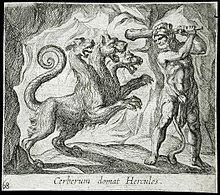
Plato (c. 425 – 348 BC) refers to Cerberus' composite nature, citing Cerberus, along with Scylla and the Chimera, as an case from "aboriginal fables" of a creature composed of many animal forms "grown together in one".[100] Euphorion of Chalcis (tertiary century BC) describes Cerberus as having multiple snake tails, and eyes that flashed, like sparks from a blacksmith's forge, or the volcaninc Mountain Etna.[101] From Euphorion, besides comes the first mention of a story which told that at Heraclea Pontica, where Cerberus was brought out of the underworld, past Heracles, Cerberus "vomited bile" from which the poisonous aconite plant grew up.[102]
Co-ordinate to Diodorus Siculus (1st century BC), the capture of Cerberus was the eleventh of Heracles' labors, the twelfth and terminal being stealing the Apples of the Hesperides.[103] Diodorus says that Heracles idea it best to first go to Athens to take part in the Eleusinian Mysteries, "Musaeus, the son of Orpheus, existence at that time in accuse of the initiatory rites", after which, he entered into the underworld "welcomed like a brother by Persephone", and "receiving the dog Cerberus in chains he carried him away to the amazement of all and exhibited him to men."
In Virgil'southward Aeneid (1st century BC), Aeneas and the Sibyl encounter Cerberus in a cave, where he "lay at vast length", filling the cave "from end to cease", blocking the archway to the underworld. Cerberus is described as "triple-throated", with "iii fierce mouths", multiple "large backs", and serpents writhing around his neck. The Sibyl throws Cerberus a loaf laced with beloved and herbs to induce slumber, enabling Aeneas to enter the underworld, then apparently for Virgil—contradicting Hesiod—Cerberus guarded the underworld confronting archway.[104] Later Virgil describes Cerberus, in his bloody cavern, crouching over half-gnawed bones.[105] In his Georgics, Virgil refers to Cerberus, his "triple jaws agape" being tamed by Orpheus' playing his lyre.[106]
Horace (65 – viii BC) as well refers to Cerberus yielding to Orphesus' lyre, here Cerberus has a single canis familiaris caput, which "like a Fury'south is fortified by a hundred snakes", with a "triple-tongued mouth" oozing "fetid breath and gore".[107]
Ovid (43 BC – AD 17/xviii) has Cerberus' mouth produce venom,[108] and like Euphorion, makes Cerberus the cause of the poisonous institute aconite.[109] Co-ordinate to Ovid, Heracles dragged Cerberus from the underworld, emerging from a cave "where 'tis fabled, the plant grew / on soil infected by Cerberian teeth", and dazzled by the daylight, Cerberus spewed out a "poison-foam", which fabricated the aconite plants growing in that location poisonous.
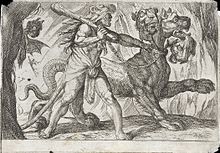
Seneca, in his tragedy Hercules Furens gives a detailed description of Cerberus and his capture.[110] Seneca'southward Cerberus has three heads, a mane of snakes, and a serpent tail, with his three heads being covered in gore, and licked by the many snakes which surround them, and with hearing so astute that he can hear "even ghosts".[111] Seneca has Heracles apply his king of beasts-pare as shield, and his wooden club, to beat Cerberus into submission, later on which Hades and Persephone, quailing on their thrones, let Heracles lead a chained and submissive Cerberus abroad. Simply upon leaving the underworld, at his start sight of daylight, a frightened Cerberus struggles furiously, and Heracles, with the help of Theseus (who had been held captive by Hades, but released, at Heracles' request) drag Cerberus into the light.[112] Seneca, similar Diodorus, has Heracles parade the captured Cerberus through Greece.[113]
Apollodorus' Cerberus has three domestic dog-heads, a serpent for a tail, and the heads of many snakes on his dorsum.[114] According to Apollodorus, Heracles' twelfth and final labor was to bring back Cerberus from Hades. Heracles start went to Eumolpus to be initiated into the Eleusinian Mysteries. Upon his inbound the underworld, all the dead abscond Heracles except for Meleager and the Gorgon Medusa. Heracles drew his sword confronting Medusa, but Hermes told Heracles that the dead are mere "empty phantoms". Heracles asked Hades (here chosen Pluto) for Cerberus, and Hades said that Heracles could take Cerberus provided he was able to subdue him without using weapons. Heracles institute Cerberus at the gates of Acheron, and with his arms around Cerberus, though being bitten by Cerberus' serpent tail, Heracles squeezed until Cerberus submitted. Heracles carried Cerberus abroad, showed him to Eurystheus, and then returned Cerberus to the underworld.
In an apparently unique version of the story, related by the sixth-century Advertising Pseudo-Nonnus, Heracles descended into Hades to abduct Persephone, and killed Cerberus on his way support.[115]
Iconography [edit]
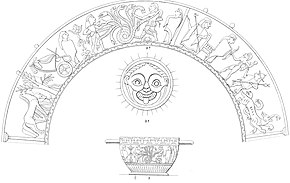
One of the two primeval depictions of the capture of Cerberus (composed of the last 5 figures on the right) shows, from right to left: Cerberus, with a single dog head and snakes rising from his body, fleeing right, Hermes, with his characteristic hat (petasos) and caduceus, Heracles, with quiver on his dorsum, rock in left paw, and bow in right, a goddess, standing in front of Hades' throne, facing Heracles, and Hades, with scepter, fleeing left. Drawing of a lost Corinthian cup (c. 590–580 BC) from Argos.
The capture of Cerberus was a popular theme in ancient Greek and Roman fine art.[116] The primeval depictions date from the beginning of the sixth century BC. One of the ii earliest depictions, a Corinthian loving cup (c. 590–580 BC) from Argos (now lost),[117] shows a naked Heracles, with quiver on his back and bow in his right hand, striding left, accompanied past Hermes. Heracles threatens Hades with a rock, who flees left, while a goddess, possibly Persephone or possibly Athena, standing in front of Hades' throne, prevents the attack. Cerberus, with a single canine head and snakes ascent from his head and body, flees correct. On the far correct a cavalcade indicates the entrance to Hades' palace. Many of the elements of this scene—Hermes, Athena, Hades, Persephone, and a column or portico—are common occurrences in later works. The other primeval depiction, a relief pithos fragment from Crete (c. 590–570 BC), is thought to show a single lion-headed Cerberus with a snake (open-mouthed) over his back existence led to the right.[118]
A mid-sixth-century BC Laconian cup by the Hunt Painter adds several new features to the scene which also become mutual in later works: iii heads, a snake tail, Cerberus' concatenation and Heracles' club. Here Cerberus has iii canine heads, is covered by a shaggy coat of snakes, and has a tail which ends in a ophidian head. He is being held on a chain ternion by Heracles who holds his club raised over head.[119]
In Greek art, the vast majority of depictions of Heracles and Cerberus occur on Attic vases.[120] Although the lost Corinthian cup shows Cerberus with a single dog caput, and the relief pithos fragment (c. 590–570 BC) apparently shows a single panthera leo-headed Cerberus, in Attic vase painting Cerberus unremarkably has 2 dog heads.[121] In other art, as in the Laconian loving cup, Cerberus is usually three-headed.[122] Occasionally in Roman art Cerberus is shown with a big central king of beasts head and two smaller dog heads on either side.[123]

Heracles with club in his right hand raised over head and leash in left hand drives alee of him a two-headed Cerberus with mane downwards his necks and back and a snake tail. A neck-amphora (c. 530–515 BC) from Vulci (Munich 1493).[124]
As in the Corinthian and Laconian cups (and perchance the relief pithos fragment), Cerberus is oftentimes depicted every bit function snake.[125] In Attic vase painting, Cerberus is usually shown with a ophidian for a tail or a tail which ends in the head of a snake.[126] Snakes are also often shown rising from various parts of his torso including snout, caput, cervix, back, ankles, and paws.
2 Attic amphoras from Vulci, one (c. 530–515 BC) by the Bucci Painter (Munich 1493),[127] the other (c. 525–510 BC) past the Andokides painter (Louvre F204),[128] in addition to the usual two heads and snake tail, prove Cerberus with a mane down his necks and dorsum, some other typical Cerberian characteristic of Attic vase painting.[129] Andokides' amphora also has a small snake curling upwards from each of Cerberus' two heads.
Besides this lion-like mane and the occasional lion-head mentioned higher up, Cerberus was sometimes shown with other leonine features. A pitcher (c. 530–500) shows Cerberus with mane and claws,[130] while a showtime-century BC sardonyx cameo shows Cerberus with leonine body and paws.[131] In add-on, a limestone relief fragment from Taranto (c. 320–300 BC) shows Cerberus with three lion-like heads.[132]
During the second quarter of the 5th century BC the capture of Cerberus disappears from Attic vase painting.[133] After the early third century BC, the subject becomes rare everywhere until the Roman period. In Roman art the capture of Cerberus is usually shown together with other labors. Heracles and Cerberus are usually alone, with Heracles leading Cerberus.[134]
Etymology [edit]

The etymology of Cerberus' proper noun is uncertain. Ogden[136] refers to attempts to establish an Indo-European etymology as "not yet successful". It has been claimed to be related to the Sanskrit word सर्वरा sarvarā, used as an epithet of i of the dogs of Yama, from a Proto-Indo-European give-and-take *k̑érberos, significant "spotted".[137] Lincoln (1991),[138] among others, critiques this etymology. Lincoln notes a similarity between Cerberus and the Norse mythological dog Garmr, relating both names to a Proto-Indo-European root *ger- "to growl" (mayhap with the suffixes -*m/*b and -*r). However, as Ogden observes, this assay really requires Kerberos and Garmr to be derived from ii different Indo-European roots (*ker- and *gher- respectively), so does non actually establish a human relationship between the two names.
Though probably not Greek, Greek etymologies for Cerberus have been offered. An etymology given past Servius (the late-fourth-century commentator on Virgil)—but rejected by Ogden—derives Cerberus from the Greek give-and-take creoboros meaning "flesh-devouring".[139] Another suggested etymology derives Cerberus from "Ker berethrou", meaning "evil of the pit".[140]
Cerberus rationalized [edit]
At least as early every bit the sixth century BC, some ancient writers attempted to explicate away various fantastical features of Greek mythology;[141] included in these are various rationalized accounts of the Cerberus story.[142] The primeval such account (tardily 6th century BC) is that of Hecataeus of Miletus.[143] In his account Cerberus was not a dog at all, only rather simply a big venomous serpent, which lived on Tainaron. The snake was called the "hound of Hades" only because anyone bitten by it died immediately, and it was this snake that Heracles brought to Eurystheus. The geographer Pausanias (who preserves for us Hecataeus' version of the story) points out that, since Homer does not draw Cerberus, Hecataeus' account does not necessarily conflict with Homer, since Homer'due south "Hound of Hades" may non in fact refer to an actual dog.[144]
Other rationalized accounts make Cerberus out to be a normal dog. According to Palaephatus (4th century BC)[145] Cerberus was one of the ii dogs who guarded the cattle of Geryon, the other being Orthrus. Geryon lived in a metropolis named Tricranium (in Greek Tricarenia, "3-Heads"),[146] from which name both Cerberus and Geryon came to exist called "3-headed". Heracles killed Orthus, and drove away Geryon's cattle, with Cerberus following along behind. Molossus, a Mycenaen, offered to buy Cerberus from Eurystheus (presumably having received the canis familiaris, along with the cattle, from Heracles). Merely when Eurystheus refused, Molossus stole the dog and penned him up in a cave in Tainaron. Eurystheus commanded Heracles to observe Cerberus and bring him dorsum. Subsequently searching the entire Peloponnesus, Heracles found where it was said Cerberus was being held, went down into the cavern, and brought upward Cerberus, subsequently which it was said: "Heracles descended through the cavern into Hades and brought up Cerberus."
In the rationalized account of Philochorus, in which Heracles rescues Theseus, Perithous is eaten by Cerberus.[147] In this version of the story, Aidoneus (i.e., "Hades") is the mortal king of the Molossians, with a wife named Persephone, a daughter named Kore (another name for the goddess Persephone) and a large mortal canis familiaris named Cerberus, with whom all suitors of his girl were required to fight. Subsequently having stolen Helen, to be Theseus' wife, Theseus and Perithous, attempt to housebreak Kore, for Perithous, but Aidoneus catches the two heroes, imprisons Theseus, and feeds Perithous to Cerberus. Subsequently, while a guest of Aidoneus, Heracles asks Aidoneus to release Theseus, as a favor, which Aidoneus grants.
A 2nd-century Advert Greek known every bit Heraclitus the paradoxographer (not to be confused with the fifth-century BC Greek philosopher Heraclitus)—claimed that Cerberus had 2 pups that were never away from their father, which made Cerberus announced to exist iii-headed.[148]
Cerberus allegorized [edit]
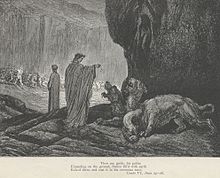
Virgil feeding Cerberus world in the Third Circumvolve of Hell. Illustration from Dante'due south Inferno past Gustave Doré.
Servius, a medieval commentator on Virgil's Aeneid, derived Cerberus' name from the Greek give-and-take creoboros significant "flesh-devouring" (see above), and held that Cerberus symbolized the corpse-consuming earth, with Heracles' triumph over Cerberus representing his victory over earthly desires.[149] Later, the mythographer Fulgentius, allegorizes Cerberus' 3 heads as representing the iii origins of human strife: "nature, crusade, and accident", and (cartoon on the same flesh-devouring etymology as Servius) as symbolizing "the three ages—infancy, youth, old age, at which expiry enters the earth."[150] The Byzantine historian and bishop Eusebius wrote that Cerberus was represented with 3 heads, because the positions of the sunday above the earth are iii—rising, midday, and setting.[151]
The later Vatican Mythographers repeat and aggrandize upon the traditions of Servius and Fulgentius. All three Vatican Mythographers repeat Servius' derivation of Cerberus' proper name from creoboros.[152] The Second Vatican Mythographer repeats (virtually word for give-and-take) what Fulgentius had to say about Cerberus,[153] while the Third Vatican Mythographer, in some other very similar passage to Fugentius', says (more than specifically than Fugentius), that for "the philosophers" Cerberus represented hatred, his three heads symbolizing the three kinds of human hatred: natural, causal, and coincidental (i.e. adventitious).[154]
The 2d and Third Vatican Mythographers, note that the three brothers Zeus, Poseidon and Hades each have tripartite insignia, associating Hades' 3-headed Cerberus, with Zeus' three-forked thunderbolt, and Poseidon's 3-pronged trident, while the Third Vatican Mythographer adds that "some philosophers think of Cerberus as the tripartite earth: Asia, Africa, and Europe. This world, swallowing up bodies, sends souls to Tartarus."[155]
Virgil described Cerberus as "ravenous" (fame rabida),[156] and a rapacious Cerberus became proverbial. Thus Cerberus came to symbolize avarice,[157] and so, for example, in Dante's Inferno, Cerberus is placed in the Tertiary Circle of Hell, guarding over the gluttons, where he "rends the spirits, flays and quarters them,"[158] and Dante (possibly echoing Servius' association of Cerbeus with world) has his guide Virgil have up handfuls of earth and throw them into Cerberus' "rapacious gullets."[159]
Constellation [edit]
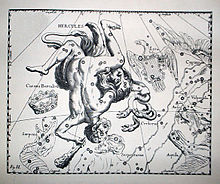
In the constellation Cerberus introduced by Johannes Hevelius in 1687, Cerberus is fatigued as a three-headed snake, held in Hercules' manus (previously these stars had been depicted as a co-operative of the tree on which grew the Apples of the Hesperides).[160]
Snake genus [edit]
In 1829 French naturalist Georges Cuvier gave the name Cerberus to a genus of Asian snakes, which are normally called "dog-faced water snakes" in English.[161]
Come across also [edit]
- List of Greek mythological creatures
- Dormarch – office of the Cŵn Annwn
- Hellhound
Notes [edit]
- ^ LIMC Herakles 2616 Archived ten July 2017 at the Wayback Machine (Smallwood, pp. 92, 98); Ogden 2013b, p. 63; Ogden 2013a, p. 105; Gantz, p. 22; Perseus Louvre E 701 (Vase).
- ^ "Cerberus". Merriam-Webster Online Dictionary. Merriam-Webster. Retrieved 16 July 2009.
- ^ Hesiod, Theogony 300–314, Acusilaus, fragment 6 (Freeman, p. 15), Hyginus, Fabulae Preface, 151 Archived 5 November 2014 at the Wayback Machine, and Quintus Smyrnaeus, Posthomerica (or Fall of Troy) 6.260–268 (pp. 272–275) all have Cerberus as the offspring of Typhon and Echidna, while Bacchylides, Ode 5.56–62, Sophocles, Women of Trachis 1097–1099, Callimachus, fragment 515 Pfeiffer (Trypanis, pp. 258–259), and Ovid, Metamorphoses four.500–501, 7.406–409 all take Cerberus as the offspring of Echidna without naming a father.
- ^ Hesiod, Theogony 309–324 (although it is not certain whom Hesiod meant equally the mother of the Chimera: Echidna, the Hydra, or Ceto); Apollodorus, 2.5.10, two.3.1; Hyginus, Fabulae Preface.
- ^ Gantz, p. 22; Ogden 2013a, p. 105, with n. 182; Hesiod, Theogony 311–312; Pindar, fragment F249a/b SM, from a lost Pindar poem on Heracles in the underworld, co-ordinate to a scholia on the Iliad.
- ^ Ogden 2013a, pp. 105–106, with n. 183; Sophocles, Women of Trachis 22–25 ("3-bodied"), 1097–1099; Euripides, Heracles 610–611, 1276–1278; Virgil, Aeneid 6.417–421 ("triple-throated", "3 fierce mouths"), Georgics 4.483 ("triple jaws"); Ovid, Metamorphoses four.449–451 ("3-visaged mouths", "triple-barking"), 9.185 ("triple form"), 10.21–22 ("iii necks"), 10.65–66 ("triple necks"), Heroides 9.93–94 (pp. 114–115) ("three-fold"); Seneca, Agamemnon 859–862 (pp. 198–199) ("triple bondage"), Hercules Furens sixty–62 (pp. 52–53) ("triple necks"), 782–784 (pp. 110–111); Statius, Silvae 2.i.183–184 (I pp. ninety–91) ("triple jaws"), iii.3.27 (I pp. 168–169) ("threefold"), Thebaid, ii.31 (I pp. 396–397), ("threefold"), 2.53 (I pp. 398–399) ("tri-formed"); Propertius, Elegies 3.5.44 (pp. 234–237) ("iii throats"), 3.18.23 (pp. 284–285) ("iii heads") Apollodorus, 2.v.12 ("three heads of dogs").
- ^ West, David, p. 108; Ogden 2013a, p. 107; Horace, Odes iii.11.17–20 (West, David, pp. 101–103) ("a hundred snakes … triple-tongued"), Odes two.13.33–36 ("hundred-headed"), Odes 2.19.29–32 ("triple tongue").
- ^ Apollodorus, 2.5.12; Tzetzes, Chiliades 2.36.389–392 (Greek: Kiessling, pp. 55–56; English translation: Berkowitz, p. 48); Frazer's note 1 to Apollodorus, two.5.12.
- ^ LIMC Herakles 2554 Archived 10 July 2017 at the Wayback Machine (Smallwood, pp. 87, 98); Schefold 1992, pp. 130–131, fig. 152; Beazley Archive 200011; Perseus Louvre F 204 (Vase).
- ^ Smallwood, p. 87; Gantz, p. 22; Ogden 2013a, p. 106. According to Gantz, "Presumably the frequent variant of two heads arose from logistical bug in draftmanship," and Ogden wonders if "such images salute or establish a tradition of a two-headed Cerberus, or are we to imagine a third head concealed behind the two that can be seen?" For one-headed Cerberus, run into LIMC Herakles 2553, 2570, 2576, 2591, 2621.
- ^ LIMC Herakles 2553 (Smallwood, pp. 87, 97–98); Gantz, p. 22; Ogden 2013a, p. 106, with northward. 184. A relief pithos fragment (c. 590–570 BC) LIMC Herakles 2621 (Smallwood, p. 92), seems to show a single king of beasts-headed Cerberus, with snake (open-mouthed) over his dorsum.
- ^ LIMC Herakles 2605 Archived 10 July 2017 at the Wayback Machine (Smallwood, p. 91); Schefold 1992, p. 129; Gantz, p. 22; Ogden 2013a, p. 106, with n. 185.
- ^ Ogden 2013b, p. 63.
- ^ Hecataeus of Miletus, fr. *27 a Fowler (Fowler 2000, p. 136) (apud Pausanias, 3.25.four–5), (cf. FGrH 1 F27); Ogden 2013a, p. 107.
- ^ Plato Republic 588c.
- ^ Euphorian, fragment 71 Lightfoot (Lightfoot, pp. 300–303; Ogden 2013b, pp. 69–70); Ogden 2013a, p. 107.
- ^ Euphorion, fragment 41a Lightfoot, (Lightfoot, pp. 272–275 = Herodorus fragment 31 Fowler).
- ^ Virgil, Aeneid vi.419,
- ^ Ovid, Metamorphoses four.500–501.
- ^ Ovid, Metamorphoses 10.22–24
- ^ Ovid, Heroides 9.93–94 (pp. 114–115).
- ^ Seneca, Hercules Furens 785–812 (pp. 112–113). Run across likewise Lucan, Pharsalia 6.664–665, which has Cerberus' heads "bristling" with snakes; and Apollodorus, 2.5.12 whose Cerberus is snake-tailed and has "on his back the heads of all sorts of snakes".
- ^ Euripides Heracles 22–25.
- ^ Virgil, Aeneid 6.422.
- ^ Hesiod, Theogony 311.
- ^ Seneca, Hercules Furens 788–791 (pp. 112–113).
- ^ LIMC Herakles 2599ad; Beazley Archive 302005. Reproduced from Baumeister's Denkmäler des klassichen Alterthums, volume I., figure 730 (text on p. 663).
- ^ For discussions of Heracles' capture of Cerberus, see Gantz, pp. 413–416; Hard, pp. 268–269; Ogden 2013a, pp. 104–115.
- ^ Homer, Iliad 8.367–368; compare with Odyssey xi.620–626. Heracles is as well given the job by Eurystheus in Hecataeus of Miletus, fr. *27 a Fowler (Fowler 2000, p. 136) (apud Pausanias, three.25.four–5), (cf. FGrH 1 F27), Euripides, Heracles 1276–1278, Pirithous TrGF 43 F1 lines x–14 (Ogden 2013b, pp. 69–70; Collard and Cropp, pp. 646–647); Euphorian, fragment 71 Lightfoot (Lightfoot, pp. 300–303; Ogden 2013b, pp. 69–70); Diodorus Siculus, 4.25.one; Hyginus, Fabulae 32.
- ^ Apollodorus, ii.v.12. And then likewise in Euphorian, fragment 71 Lightfoot 13 (Lightfoot, pp. 300–303; Ogden 2013b, pp. 69–70), and Tzetzes, Chiliades 2.36.388–410 (Greek: Kiessling, pp. 55–56; English translation: Berkowitz, p. 48). Euripides, Heracles 22–25, calls this labor the last. Still co-ordinate to Diodorus Siculus, 4.25.2 this labor was the eleventh and next to last, the twelfth existence stealig the Apples of the Hesperides.
- ^ Pirthous TrGF 43 F1 lines x–fourteen (Ogden 2013b, p. 70; Collard and Cropp, pp. 646–647); Ogden 2013a, p. 113.
- ^ Euripides Heracles 612–613; Papadopoulou, p. 163.
- ^ Diodorus Siculus, 4.25.one–2.
- ^ Apollodorus, 2.5.12; so also, Tzetzes, Chiliades 2.36.394 (Greek: Kiessling, pp. 55–56; English translation: Berkowitz, p. 48). Apollodorus adds that, since information technology was unlawful for foreigners to be initiated, Heracles was adopted by Pylius, and that before Heracles could exist initiated, he first had to be "cleansed of the slaughter of the centaurs"; come across also Frazer'due south note 2 to Apollodorus, two.five.12.
- ^ Homer, Odyssey xi.620–626; compare with Pausanias, 8.18.3. Apollodorus, 2.v.i likewise has Hermes aiding Heracles in the underworld.
- ^ Ogden 2013a, p. 110; Fowler 2013, p. 305 with due north. 159. An entrance at Tainaron is mentioned as early every bit Pindar, Pythian 4.44.
- ^ Hecataeus of Miletus, fr. *27 a Fowler (Fowler 2000, p. 136) (apud Pausanias, iii.25.iv–five), (cf. FGrH one F27); Euripides, Heracles 22–25; Seneca, Hercules Furens 662–696 (pp. 102–105); Apollodorus, 2.v.1, so also, Tzetzes, Chiliades 2.36.395 (Greek: Kiessling, pp. 55–56; English translation: Berkowitz, p. 48).
- ^ Xenophon of Athens, Anabasis 6.ii.2.
- ^ Ogden 2013a, p. 108.
- ^ Gantz, pp. 291–295.
- ^ Apollodorus, 2.v.12, E.1.24; compare with Tzetzes, Chiliades 2.36.396–410, iv.31.911–916 (Greek: Kiessling, pp. 55–56, 153; English translation: Berkowitz, pp. 48, 138).
- ^ LIMC Herakles 3519; Gantz, p. 292; Schelfold 1966, pp. 68–69 fig. 24.
- ^ Euripides Heracles 1169–1170., :1221–1222; Gantz, p. 293.
- ^ Gantz, P. 293; Collard and Cropp, p. 637; Pirithous TrGF 43 F1 Hypothesis (Collard and Cropp, pp. 640–641).
- ^ Philochorus, FGrH 328 F18a, b, c; Harding, pp. 67–70; Ogden 2013b, p. 73; Ogden 2013a, p. 109 (Philochorus F18a = Plutarch, Theseus 35.ane, compare with 31.1–4).
- ^ Diodorus Siculus, 4.26.i.
- ^ Diodorus Siculus, four.63.4; Gantz, pp. 294–295.
- ^ Hyginus, Fabulae 79.
- ^ Beazley Archive 10772.
- ^ Ogden 2013a, pp. 110–112.
- ^ Apollodorus, 2.5.1; compare with Tzetzes, Chiliades ii.36.400–401 (Greek: Kiessling, pp. 55–56; English language translation: Berkowitz, p. 48) which says that Heracles mastered Cerberus "Covered only by his lion skin and breast piece / Autonomously from the residue of his weapons, simply as Pluton [i.e. Hades] said".
- ^ Homer, Iliad 5.395–397; Kirk, p. 102; Ogden 2013a, pp. 110–111; Gantz, pp. 70, 414, 416. Panyassis F26 W (Due west, M. 50., (pp. 212–213) has "Elean Hades" being shot past Heracles. Compare with Seneca, Hercules Furens 48–51 (pp. 52–53), where Heracles brings back "spoils of triumph over that conquered king … subdued Dis".
- ^ Schol. Homer Iliad 5.395–397 (Ogden 2013b, p. 66); Ogden 2013a, p. 112; Gantz, p. 416.
- ^ Smallwood, pp. 96–97; Ogden 2013a, p. 111.
- ^ Ogden 2013a, p. 111.
- ^ Euripides Heracles 610–613; Ogden 2013b, pp. 69–70. This question is echoed in Seneca, Hercules Furens 760–761 (pp. 110–111), where Amphitryon asks "Is it spoil [Heracles] brings, or a willing gift from his uncle.
- ^ Pirithous TrGF 43 F1 Hypothesis (Collard and Cropp, pp. 640–641).
- ^ Diodorus Siculus, four.26.i.
- ^ Aristophanes, Frogs 465–469; Ogden 2013b, pp. 65–66.
- ^ Seneca, Hercules Furens 797–812 (pp. 112–113).
- ^ Ovid, Metamorphoses vii.409–413.
- ^ Ogden 2013a, pp. 107–108, 112–113.
- ^ Strabo, 8.5.1.
- ^ Seneca, Hercules Furens 663 (pp. 102–105) (entrance), 813 (pp. 112–113) (leave). Seneca'southward account may reflect a much older tradition rationalized past Hecataeus of Miletus, fr. *27 a Fowler (Fowler 2000, p. 136) (apud Pausanias, 3.25.4–v), (cf. FGrH i F27), run across Ogden 2013a, p. 112.
- ^ Apollodorus, 2.5.12. Tzetzes, Chiliades ii.36.404 (Greek: Kiessling, pp. 55–56; English translation: Berkowitz, p. 48) also has Cerberus brought upwards at Troezen.
- ^ Pausanias, 2.31.two.
- ^ Ogden 2013a, pp. 107–108, 112; Ogden 2013b, pp. 68–69; Fowler 2013, pp. 305 ff.; Herodorus fragment 31 Fowler (= Euphorion fragment 41a Lightfoot); Euphorion, fragment 41 Lightfoot (Lightfoot, pp. 272–275); Diodorus Siculus, 14.31.3; Ovid, Metamorphoses seven.406–419; Pomponius Mela, 1.92; Pliny, Natural History 27.4; Schol. Nicander alexipharmaca 13b; Dionysius Periegetes, 788–792; Eustathius, Commentary on Dionysius Periegetes 788–792; First Vatican Mythographer, 1.57 (Ogden 2013b, pp. 73–74; Pepin, p. 36). For aconite in the vicinity of Heraclea, run into as well Theophrastus, Historia Plantarum 9.16.4 pp. 298–299; Strabo, 12.3.7; Pliny, Natural History 6.4; Arrian, FGrH 156 F76a apud Eustathius of Thessalonica, Commentary on Dionysius Periegetes 788–792.
- ^ Schol. Apollonius of Rhodes Argonautica 2.353 (Ogden 2013b, p. 68); compare with Euphorion, fragment 41a Lightfoot, (Lightfoot, pp. 272–275 = Herodorus fragment 31 Fowler).
- ^ Ovid, Metamorphoses 7.413–419, which has Cerberus brought upwards from the underworld through a cavern on "the shores of Scythia, where, 'tis fabled, the [aconite] plant grew on soil infected past Cerberian teeth."
- ^ Seneca, Hercules Furens 797–821 (pp. 112–115); see too Agamemnon, 859–862 (pp. 198–199), which has Cerberus "fearing the colour of the unknown calorie-free."
- ^ Pausanias, 2.35.10; Euripides, Heracles 615 (Ogden 2013b, pp. 69–70).
- ^ Pausanias, nine.34.v.
- ^ Ogden 2013a, pp. 112–113.
- ^ Ogden 2013a, p. 113; Ogden 2013b, pp. 69–71.
- ^ Euphorian, fragment 71 Lightfoot fourteen–xv (Lightfoot, pp. 300–303; Ogden 2013b, pp. 69–70).
- ^ Diodorus Siculus, iv.26.1.
- ^ Seneca, Hercules Furens 46–62 (pp. 52–53).
- ^ Seneca, Hercules Furens 827–829 (pp. 114–115).
- ^ Apollodorus, 2.five.12.
- ^ Hesychius of Alexandria southward.5. eleutheron hydor (Ogden 2013b, pp. 69–71); Ogden 2013a, p. 114.
- ^ For a word of sources meet Ogden 2013a, pp. 104–114; Ogden 2013b, pp. 63–74; Gantz, pp. 22–23, 413–416.
- ^ Homer, Iliad 8.367–368, Odyssey 11.620–626.
- ^ Homer, Iliad 5.395–397; Kirk, p. 102; Ogden 2013a, pp. 110–111; Gantz, pp. 70, 414, 416.
- ^ Hesiod, Theogony 300–312.
- ^ Hesiod, Theogony 767–774; Ogden 2013b, pp. 65.
- ^ Bowra, p. 94; Ogden 2013a, p. 105 due north. 182.
- ^ Gantz, p. 22; Ogden 2013a, p. 106, with n. 184; LIMC Herakles 2553.
- ^ Bowra, p. 120.
- ^ Gantz, p. 22; Ogden 2013a, p. 106, with n. 185; LIMC Herakles 2605 Archived x July 2017 at the Wayback Machine; Schefold 1992, p. 129; Pipili, fig. viii.
- ^ Pindar fragment F249a/b SM, from a lost Pindar verse form on Heracles in the underworld, according to a scholia on the Iliad, Gantz p. 22; Ogden 2013a, p. 105, with n. 182.
- ^ Bacchylides, Ode 5.56–62.
- ^ Sophocles, Women of Trachis 1097–1099.
- ^ Sophocles, Oedipus at Colonus 1568–1578; Markantonatos, pp. 129–130.
- ^ Euripides Heracles 1276–1278.
- ^ Euripides Heracles 22–25.
- ^ Euripides Heracles 22–25.
- ^ Euripides Heracles 612–613; Papadopoulou, p. 163; Ogden 2013b, pp. 69–seventy.
- ^ Euripides Heracles 22–25.
- ^ Pirithous TrGF 43 F1 Hypothesis (Collard and Cropp, pp. 640–641). For the question of authorship see Gantz, p. 293; Collard and Cropp, pp. 629–635, p. 636.
- ^ Plato Republic 588c.
- ^ Euphorian, fragment 71 Lightfoot (Lightfoot, pp. 300–303; Ogden 2013b, pp. 69–70); Ogden 2013a, p. 107.
- ^ Schol. Apollonius of Rhodes Argonautica 2.353 (Ogden 2013b, p. 68); compare with Euphorion, fragment 41a Lightfoot (Lightfoot, pp. 272–275).
- ^ Diodorus Siculus, 4.25.i, 26.1–2; Ogden 2013b, p. 66.
- ^ Virgil, Aeneid 6.417–425; Ogden 2013b, p. 71; Ogden 2013a, p, 109; Ogden 2013b, p. 69. Compare with Apuleius, Metamorphoses 6.nineteen (pp. 284–285), where following Virgil, exiting (as well as entering) the underworld is achieved past giving Cerberus a mead-soaked barley cake.
- ^ Virgil, Aeneid 8.296–297.
- ^ Virgil, Georgics 4.483.
- ^ Horace, Odes 3.11.13–20; West, David, pp. 101–103; Ogden 2013a, p. 108. Compare with Odes 2.13.33–36 ("hundred-headed", referring perhaps to the i hundred snakes), Odes 2.19.29–32 ("triple tongue").
- ^ Ovid, Metamorphoses four.500–501.
- ^ Ovid, Metamorphoses 7.406 ff.; Ogden 2013a, p. 108.
- ^ Seneca, Hercules Furens 782–821 (pp. 110–115); Ogden 2013b, pp. 66–68.
- ^ Seneca, Hercules Furens 782–791 (pp. 110–113).
- ^ Seneca, Hercules Furens 797–821 (pp. 112–115); meet also Agamemnon, 859–862 (pp. 198–199), which has Cerberus "fearing the colour of the unknown low-cal."
- ^ Seneca, Hercules Furens 46–62 (pp. 52–53).
- ^ Apollodorus, ii.5.12; Ogden 2013b, pp. 64–65.
- ^ Pseudo-Nonnus, 4.51 (Nimmo Smith, p. 37); Ogden 2013a, p. 114.
- ^ Lexicon Iconographicum Mythologiae Classicae (LIMC), Herakles 1697–1761 (Boardman, pp. 5–sixteen), 2553–2675 (Smallwood, pp. 85–100); Schefold 1992, pp. 129–132.
- ^ LIMC Herakles 2553 (Smallwood, pp. 87, 97–98); Schefold 1966, p. 68 fig. 23; Schefold 1992, p. 129; Ogden 2013a, pp. 106, 111; Gantz, pp. 22, 413–414.
- ^ LIMC Herakles 2621 (Smallwood, pp. 92, 97); Ogden 2013a, p. 108. Cerberus is peradventure existence led by Heracles, but only the left arm is preserved. According to Smallwood, the identification every bit Heracles and Cerberus is "suggested by Dunbabin, taken as certain past Schäfer" (p. 92), and "too footling of the fragment is preserved for a secure identification".
- ^ LIMC Herakles 2605 Archived x July 2017 at the Wayback Machine (Smallwood, p. 91); Schefold 1992, pp. 129–130; Pipili, p. 5, fig. eight; Gantz, p. 22; Ogden 2013a, p. 106, 111 with north. 185, p. 111 with n. 230.
- ^ Schefold 1992, p. 98.
- ^ Schefold 1992, p. 129; Smallwood, p. 87. Exceptions include: LIMC Heracles 2570, 2576 (ane head).
- ^ Smallwood, pp. 87, 93. Exceptions include: LIMC Herakles 2553, 2591, 2621 (ane head), 2579 (two heads).
- ^ LIMC Herakles 2640, 2642, 2656, 2666, Smallwood, p. 93.
- ^ LIMC Herakles 2604 (Smallwood, p. 91); Beazley Archive 301639.
- ^ Smallwood, p. 87; Ogden 2013b p. 63. Examples include: LIMC Herakles 2553–4, 2560, 2571, 2579, 2581, 2586, 2588, 2595, 2600, 2603–6, 2610–11, 2616, 2621, 2628).
- ^ Smallwood, p. 87.
- ^ LIMC Herakles 2604 (Smallwood, p. 91); Beazley Archive 301639.
- ^ LIMC Herakles 2554 Archived 10 July 2017 at the Wayback Automobile (Smallwood, pp. 87, 98); Schefold 1992, pp. 130–131, fig. 152; Beazley Annal 200011; Perseus Louvre F 204 (Vase).
- ^ Smallwood, pp. 8, 91.
- ^ LIMC Herakles 2610 (Smallwood, p. 91); Buitron, Worcester MA 1935.59; Beazley Annal 351415.
- ^ LIMC Herakles 2628 (Smallwood, p. 93).
- ^ LIMC Herakles 2618 (Smallwood, p. 92).
- ^ Smallwood, p. 98.
- ^ Smallwood, p. 99.
- ^ LIMC Kerberos 66; Woodford, p. 29.
- ^ Ogden 2013a, p. 105.
- ^ Mallory, J. P.; Adams, D. Q. (2006). "Chapter 25.10: Death and the Otherworld". Oxford Introduction to Proto-Indo-European and the Proto-Indo-European Earth . Oxford, GBR: Oxford University Press. p. 439. ISBN978-0-19-928791-8. OCLC 139999117.
- ^ Lincoln, pp. 96–97.
- ^ Servius on Virgil, Aeneid 6.395; Ogden 2013a, p. 190; compare with Fulgentius, Mythologies 1.6 (Whitbread, pp. 51–52); First Vatican Mythographer, 1.57 (Ogden 2013b, pp. 73–74; Pepin, p. 36); Second Vatican Mythographer, 13 (Pepin, 106), 173 (Pepin, p. 171); Third Vatican Mythographer, 13.4 (Pepin, p. 324). According to Ogden, 2013b, p. 74, "creoboros is a 18-carat Greek word and does indeed hateful 'mankind-devouring', but it has no part to play in the genuine etymology of Cerberus's name, which remains obscure".
- ^ Room, p. 88.
- ^ Stern, p. 7; Ogden 2013a, p. 183.
- ^ Ogden 2013a, pp. 184–185.
- ^ Hecataeus of Miletus, fr. *27 a Fowler (Fowler 2000, p. 136) (apud Pausanias, three.25.4–5), (cf. FGrH ane F27); Hawes, p. viii; Hopman, p. 182; Ogden 2013a, p. 107; Ogden 2013b, pp. 72–73.
- ^ Pausanias, 3.25.6.
- ^ Palaephatus, On Unbelievable Tales 39 (Stern, pp. 71–72).
- ^ Ogden 2013a, p. 187.
- ^ Philochorus, FGrH 328 F18a (= Plutarch, Theseus 35.1), F18b, F18c; Harding, pp. 68–70; Ogden 2013b, p. 73; Ogden 2013a, p. 109; Gantz, p. 295; Collard and Cropp, p. 637. Compare with Plutarch, Theseus 31.1–4; Tzetzes, Chiliades 2.36.388–411 (Greek: Kiessling, pp. 55–56; English translation: Berkowitz, p. 48), 4.31.911–916 (Kiessling, p. 153; Berkowitz, p. 138).
- ^ Ogden 2013b, p. 73.
- ^ Servius on Virgil, Aeneid half dozen.395; Ogden 2013a, p. 190. For others who followed Servius in interpreting Cerberus as symbolizing the corruption of flesh, in both the literal and moral senses, see Brumble, pp. 68–69.
- ^ Fulgentius, Mythologies 1.half-dozen (Whitbread, pp. 51–52); Ogden 2013a, p. 190.
- ^ Eusebius, Training of the Gospels 3.11.sixteen.
- ^ First Vatican Mythographer, 1.57 (Ogden 2013b, pp. 73–74; Pepin, p. 36); 2nd Vatican Mythographer, 173 (Pepin, p. 171); Third Vatican Mythographer, 13.4 (Pepin, p. 324).
- ^ Second Vatican Mythographer, thirteen (Pepin, p. 106).
- ^ 3rd Vatican Mythographer 6.22 (Pepin, p. 171).
- ^ Second Vatican Mythographer, 13 (Pepin, p. 106); 3rd Vatican Mythographer 6.22 (Pepin, p. 171). For others who associated Cerberus' three heads with the three continents run into Brumble, p. 69.
- ^ Virgil, Aeneid 6.421.
- ^ Wilson-Okamura, p. 169; Brumble, p. 69.
- ^ Dante, Inferno vi.13–18
- ^ Dante, Inferno 6.25–27; Lansing, p. 154.
- ^ "Ian Ridpath'southward 'Star Tales'". Ianridpath.com. Retrieved seven July 2012.
- ^ Beolens, Bo; Watkins, Michael; Grayson, Michael (2011). The Eponym Dictionary of Reptiles. Baltimore: Johns Hopkins University Press. 13 + 296 pp. ISBN 978-ane-4214-0135-5. ("Cerberus", p. 50).
References [edit]
- Apollodorus, Apollodorus, The Library, with an English Translation past Sir James George Frazer, F.B.A., F.R.Due south. in 2 Volumes. Cambridge, Massachusetts, Harvard Academy Press; London, William Heinemann Ltd. 1921. Online version at the Perseus Digital Library.
- Apuleius, Metamorphoses (The Golden Donkey), Book I: Books 1–six. Edited and translated by J. Arthur Hanson. Loeb Classical Library No. 44. Cambridge, Massachusetts: Harvard University Press, 1996. Online version at Harvard University Press.
- Aristophanes, Frogs, Matthew Dillon, Ed., Perseus Digital Library, Tufts University, 1995. Online version at the Perseus Digital Library.
- Bacchylides, Odes, translated by Diane Arnson Svarlien. 1991. Online version at the Perseus Digital Library.
- Bloomfield, Maurice, Cerberus, the Dog of Hades: The History of an Idea, Open up Court publishing Company, 1905. Online version at Cyberspace Archive
- Bowra, C. M., Greek Lyric Poesy: From Alcman to Simonides, Clarendon Press, 2001. ISBN 978-0-xix-814329-1.
- Diodorus Siculus, Diodorus Siculus: The Library of History. Translated by C. H. Oldfather. Twelve volumes. Loeb Classical Library. Cambridge, Massachusetts: Harvard Academy Press; London: William Heinemann, Ltd. 1989.
- Euripides. Fragments: Oedipus-Chrysippus. Other Fragments. Edited and translated by Christopher Collard, Martin Cropp. Loeb Classical Library No. 506. Cambridge, Massachusetts: Harvard Academy Press, 2009.
- Euripides, Heracles, translated by E. P. Coleridge in The Complete Greek Drama, edited by Whitney J. Oates and Eugene O'Neill, Jr. Volume ane. New York. Random Firm. 1938. Online version at the Perseus Digital Library.
- Fowler, R. L. (2000), Early Greek Mythography: Volume 1: Text and Introduction, Oxford University Printing, 2000. ISBN 978-0-nineteen-814740-4.
- Fowler, R. L. (2013), Early Greek Mythography: Volume 2: Commentary, Oxford University Press, 2013. ISBN 978-0-19-814741-1.
- Freeman, Kathleen, Ancilla to the Pre-Socratic Philosophers: A Complete Translation of the Fragments in Diels, Fragmente Der Vorsokratiker, Harvard University Press, 1983. ISBN 978-0-674-03501-0.
- Gantz, Timothy, Early Greek Myth: A Guide to Literary and Artistic Sources, Johns Hopkins University Press, 1996, 2 volumes: ISBN 978-0-8018-5360-9 (Vol. one), ISBN 978-0-8018-5362-three (Vol. 2).
- Hard, Robin, The Routledge Handbook of Greek Mythology: Based on H.J. Rose'due south "Handbook of Greek Mythology", Psychology Press, 2004, ISBN 9780415186360. Google Books.
- Harding, Phillip, The Story of Athens: The Fragments of the Local Chronicles of Attika, Routledge, 2007. ISBN 978-1-134-30447-9.
- Hawes, Greta, Rationalizing Myth in Antiquity, OUP Oxford, 2014. ISBN 9780191653407.
- Hesiod, Theogony, in The Homeric Hymns and Homerica with an English language Translation past Hugh Chiliad. Evelyn-White, Cambridge, Massachusetts, Harvard University Press; London, William Heinemann Ltd. 1914. Online version at the Perseus Digital Library.
- Homer, The Iliad with an English Translation past A.T. Murray, PhD in two volumes. Cambridge, Massachusetts, Harvard University Printing; London, William Heinemann, Ltd. 1924. Online version at the Perseus Digital Library.
- Homer; The Odyssey with an English language Translation past A.T. Murray, PH.D. in two volumes. Cambridge, Massachusetts, Harvard Academy Press; London, William Heinemann, Ltd. 1919. Online version at the Perseus Digital Library.
- Hopman, Marianne Govers, Scylla: Myth, Metaphor, Paradox, Cambridge University Press, 2013. ISBN 978-1-139-85185-v.
- Horace, The Odes and Carmen Saeculare of Horace. John Conington. trans. London. George Bong and Sons. 1882. Online version at the Perseus Digital Library.
- Hyginus, Gaius Julius, The Myths of Hyginus. Edited and translated by Mary A. Grant, Lawrence: University of Kansas Press, 1960.
- Kirk, G. South. 1990 The Iliad: A Commentary: Book 2, Books 5–eight, ISBN 978-0521281720.
- Lansing, Richard (editor), The Dante Encyclopedia, Routledge, 2010. ISBN 9781136849725.
- Lightfoot, J. L. Hellenistic Collection: Philitas. Alexander of Aetolia. Hermesianax. Euphorion. Parthenius. Edited and translated past J. L. Lightfoot. Loeb Classical Library No. 508. Cambridge, Massachusetts: Harvard University Press, 2010. ISBN 978-0-674-99636-half-dozen. Online version at Harvard University Press.
- Lincoln, Bruce (1991). Expiry, War, and Sacrifice: Studies in Ideology and Practice. Chicago: University of Chicago Press. ISBN978-0-226-48199-ix.
- Lucan, Pharsalia, Sir Edward Ridley. London. Longmans, Green, and Co. 1905. Online version at the Perseus Digital Library.
- Markantonatos, Andreas, Tragic Narrative: A Narratological Study of Sophocles' Oedipus at Colonus, Walter de Gruyter, 2002. ISBN 978-3-11-089588-ix.
- Nimmo Smith, Jennifer, A Christian'southward Guide to Greek Civilisation: The Pseudo-nonnus Commentaries on Sermons iv, five, 39 and 43. Liverpool Academy Printing, 2001. ISBN 9780853239178.
- Ogden, Daniel (2013a), Drakōn: Dragon Myth and Serpent Cult in the Greek and Roman Worlds, Oxford University Press, 2013. ISBN 978-0-19-955732-5.
- Ogden, Daniel (2013b), Dragons, Serpents, and Slayers in the Classical and early Christian Worlds: A sourcebook, Oxford University Press. ISBN 978-0-19-992509-iv.
- Ovid. Heroides. Amores. Translated by Grant Showerman. Revised by G. P. Goold. Loeb Classical Library 41. Cambridge, Massachusetts: Harvard Academy Press, 1977. ISBN 978-0-674-99045-six. Online version at Harvard University Printing.
- Ovid, Metamorphoses, Brookes More. Boston. Cornhill Publishing Co. 1922. Online version at the Perseus Digital Library.
- Papadopoulou, Thalia, Heracles and Euripidean Tragedy, Cambridge Academy Printing, 2005. ISBN 978-1-139-44667-9.
- Pausanias, Pausanias Description of Hellenic republic with an English Translation by W.H.S. Jones, Litt.D., and H.A. Ormerod, M.A., in iv Volumes. Cambridge, Massachusetts, Harvard University Press; London, William Heinemann Ltd. 1918. Online version at the Perseus Digital Library.
- Pepin, Ronald E., The Vatican Mythographers, Fordham University Press, 2008. ISBN 9780823228928
- Pindar, Odes, Diane Arnson Svarlien. 1990. Online version at the Perseus Digital Library.
- Pipili, Maria, Laconian Iconography of the Sixth Century B.C., Oxford University, 1987.
- Plato, Republic Books half-dozen–x, Translated by Paul Shorey, Cambridge, Massachusetts, Harvard Academy Printing; London, William Heinemann Ltd. 1969. Online version at the Perseus Digital Library
- Plutarch. Lives, Volume I: Theseus and Romulus. Lycurgus and Numa. Solon and Publicola. Translated past Bernadotte Perrin. Loeb Classical Library No. 46. Cambridge, Massachusetts: Harvard University Press, 1914. ISBN 978-0-674-99052-4. Theseus at the Perseus Digital Library.
- Propertius Elegies Edited and translated past G. P. Goold. Loeb Classical Library 18. Cambridge, Massachusetts: Harvard Academy Press, 1990. Online version at Harvard University Press.
- Quintus Smyrnaeus, Quintus Smyrnaeus: The Fall of Troy, Translator: A.S. Mode; Harvard University Press, Cambridge MA, 1913. Cyberspace Archive
- Room, Adrian, Who's Who in Classical Mythology, Gramercy Books, 2003. ISBN 0-517-22256-6.
- Schefold, Karl (1966), Myth and Legend in Early Greek Fine art, London, Thames and Hudson.
- Schefold, Karl (1992), Gods and Heroes in Late Archaic Greek Fine art, assisted by Luca Giuliani, Cambridge University Press, 1992. ISBN 978-0-521-32718-3.
- Seneca, Tragedies, Volume I: Hercules. Trojan Women. Phoenician Women. Medea. Phaedra. Edited and translated by John Thousand. Fitch. Loeb Classical Library No. 62. Cambridge, Massachusetts: Harvard University Press, 2002. ISBN 978-0-674-99602-one. Online version at Harvard University Press.
- Seneca, Tragedies, Book Two: Oedipus. Agamemnon. Thyestes. Hercules on Oeta. Octavia. Edited and translated past John M. Fitch. Loeb Classical Library No. 78. Cambridge, Massachusetts: Harvard Academy Press, 2004. ISBN 978-0-674-99610-6. Online version at Harvard Academy Press.
- Smallwood, Valerie, "G. Herakles and Kerberos (Labour Eleven)" in Lexicon Iconographicum Mythologiae Classicae (LIMC) V.1 Artemis Verlag, Zürich and Munich, 1990. ISBN 3-7608-8751-1. pp. 85–100.
- Sophocles, Women of Trachis, Translated past Robert Torrance. Houghton Mifflin. 1966. Online version at the Perseus Digital Library.
- Statius, Statius with an English language Translation by J. H. Mozley, Volume I, Silvae, Thebaid, Books I–Four, Loeb Classical Library No. 206, London: William Heinemann, Ltd., New York: G. P. Putnamm'due south Sons, 1928. ISBN 978-0-674-99226-nine. Internet Archive
- Statius, Statius with an English language Translation past J. H. Mozley, Volume II, Thebaid, Books V–XII, Achilleid, Loeb Classical Library No. 207, London: William Heinemann, Ltd., New York: G. P. Putnamm'due south Sons, 1928. ISBN 978-0-674-99228-3. Internet Annal
- Stern, Jacob, Palaephatus Πεπὶ Ὰπίστων, On Unbelievable Tales, Bolchazy-Carducci Publishers, 1996. ISBN 9780865163201.
- Trypanis, C. A., Gelzer, Thomas; Whitman, Cedric, CALLIMACHUS, MUSAEUS, Aetia, Iambi, Hecale and Other Fragments. Hero and Leander, Harvard Academy Printing, 1975. ISBN 978-0-674-99463-8.
- Tzetzes, Chiliades, editor Gottlieb Kiessling, F.C.G. Vogel, 1826. (English translation, Books Ii–Iv, by Gary Berkowitz. Internet Archive).
- Virgil, Aeneid, Theodore C. Williams. trans. Boston. Houghton Mifflin Co. 1910. Online version at the Perseus Digital Library
- Virgil, Bucolics, Aeneid, and Georgics of Vergil. J. B. Greenough. Boston. Ginn & Co. 1900. Online version at the Perseus Digital Library
- Due west, David, Horace, Odes 3, Oxford University Press, 2002. ISBN 978-0-xix-872165-9.
- West, M. L. (2003), Greek Epic Fragments: From the Seventh to the Fifth Centuries BC. Edited and translated past Martin L. West. Loeb Classical Library No. 497. Cambridge, Massachusetts: Harvard University Press, 2003. Online version at Harvard University Printing.
- Whitbread, Leslie George, Fulgentius the Mythographer. Columbus: Ohio State University Press, 1971.
- Woodford, Susan, Spier, Jeffrey, "Kerberos", in Dictionary Iconographicum Mythologiae Classicae (LIMC) VI.ane Artemis Verlag, Zürich and Munich, 1992. ISBN 3-7608-8751-1. pp. 24–32.
- Xenophon, Anabasis in Xenophon in 7 Volumes, three. Carleton L. Brownson. Harvard University Press, Cambridge, Massachusetts; William Heinemann, Ltd., London. 1922. Online version at the Perseus Digital Library.
External links [edit]
- Chisholm, Hugh, ed. (1911). "Cerberus". Encyclopædia Britannica (11th ed.). Cambridge University Printing.

Source: https://en.wikipedia.org/wiki/Cerberus
0 Response to "what three-headed mythological creature guarded the entrance to hades?"
ارسال یک نظر