Again What Was Found in the Area Set Aside for the Native People
Sioux Treaty of 1868
Groundwork
"This state of war was brought upon the states by the children of the Great Father who came to take our land from us without price."
--Spotted Tail
The report and journal of proceedings of the commission appointed to obtain certain concessions from the Sioux Indians, December 26, 1876
The history of Native Americans in Northward America dates back thousands of years. Exploration and settlement of the western Usa by Americans and Europeans wreaked havoc on the Indian peoples living at that place. In the 19th century the American drive for expansion clashed violently with the Native American resolve to preserve their lands, sovereignty, and means of life. The struggle over state has defined relations between the U.S. government and Native Americans and is well documented in the holdings of the National Archives. (From the American Originals exhibit script.)
From the 1860s through the 1870s the American frontier was filled with Indian wars and skirmishes. In 1865 a congressional committee began a study of the Indian uprisings and wars in the West, resulting in a Study on the Condition of the Indian Tribes , which was released in 1867. This report and report by the congressional committee led to an act to establish an Indian Peace Commission to end the wars and prevent futurity Indian conflicts. The United States government set out to establish a serial of Indian treaties that would force the Indians to give up their lands and motility farther west onto reservations.
In the spring of 1868 a conference was held at Fort Laramie, in nowadays day Wyoming, that resulted in a treaty with the Sioux. This treaty was to bring peace between the whites and the Sioux who agreed to settle within the Black Hills reservation in the Dakota Territory.
The Blackness Hills of Dakota are sacred to the Sioux Indians. In the 1868 treaty, signed at Fort Laramie and other military posts in Sioux country, the United States recognized the Black Hills as part of the Peachy Sioux Reservation, prepare aside for exclusive employ by the Sioux people. In 1874, nevertheless, General George A. Custer led an expedition into the Black Hills accompanied by miners who were seeking gold. Once gold was found in the Black Hills, miners were soon moving into the Sioux hunting grounds and demanding protection from the Us Regular army. Shortly, the Regular army was ordered to move against wandering bands of Sioux hunting on the range in accordance with their treaty rights. In 1876, Custer, leading an ground forces disengagement, encountered the encampment of Sioux and Cheyenne at the Fiddling Bighorn River. Custer's detachment was annihilated, but the U.s.a. would continue its boxing against the Sioux in the Black Hills until the government confiscated the country in 1877. To this day, ownership of the Black Hills remains the subject area of a legal dispute betwixt the U.Due south. government and the Sioux.
For Further Reading
Agel, Jerome. Words That Make America Peachy. New York: Random Business firm, 1997.
Colbert, David, ed. Bystander to America. New York: Pantheon Books, 1997.
Tindall, George Brown and Shi, David E. America: A Narrative History, New York: W.West. Norton and Visitor, 1992.
Ward, Geoffrey C. The West: An Illustrated History. Boston: Little Chocolate-brown and Company, 1996.
The Documents
Sioux Treaty of 1868
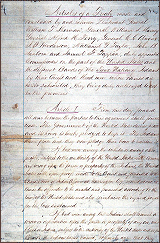
Click to Enlarge
View Pages: ane | ii | 3
National Archives and Records Assistants
General Records of the United States Regime
Record Group 11
National Archives Identifier: 299803
Full general Alfred Terry's Telegram
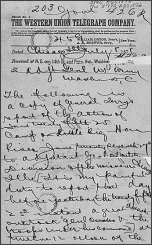
Click to Enlarge
View Pages:
Endorsement
1 | 2 | three | iv | 5 | 6 | seven | 8 | 9
10 | 11 | 12 | 13 | 14 | xv | 16
17 | 18 | 19 | 20 | 21
National Athenaeum and Records Administration
Records of the Adjutant Full general's Part, 1780's-1917
Tape Group 94
National Athenaeum Identifier: 300379
Letter from Captain John S. Poland
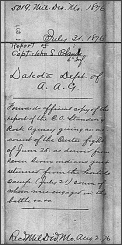
Click to Enlarge
View Pages: Endorsement | 1 | 2 | 3 | 4 | 5 | 6
National Archives and Records Administration
Records of United States Regular army Continental Commands, 1821-1920
Tape Grouping 393
National Archives Identifier: 301973
Spotted Tail, a Brulé Sioux Chief of Great Renown
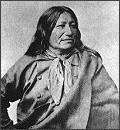
Click to Enlarge
National Archives
Still Motion-picture show Branch
111-SC-82538
National Athenaeum Identifier: 285689
Selected Photographs of Custer's 1874 Trek
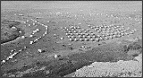
Click to Enlarge
Army camp at Subconscious Wood Creek, 1874
National Archives and Records Administration
Department of the Army. Function of the Chief of Engineers
Tape Group 77
National Archives Identifier: 519425
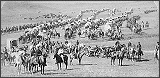
Click to Enlarge
Column of Cavalry, Artillery, and Wagons, 1874
National Archives and Records Administration
Department of the Army. Office of the Chief of Engineers
Record Grouping 77
National Archives Identifier: 519427
Commodity Citation
This commodity was written by Linda Darus Clark, a teacher at Padua Franciscan High Schoolhouse, in Parma, OH.
Source: https://www.archives.gov/education/lessons/sioux-treaty
0 Response to "Again What Was Found in the Area Set Aside for the Native People"
ارسال یک نظر